 10-Jun-2026
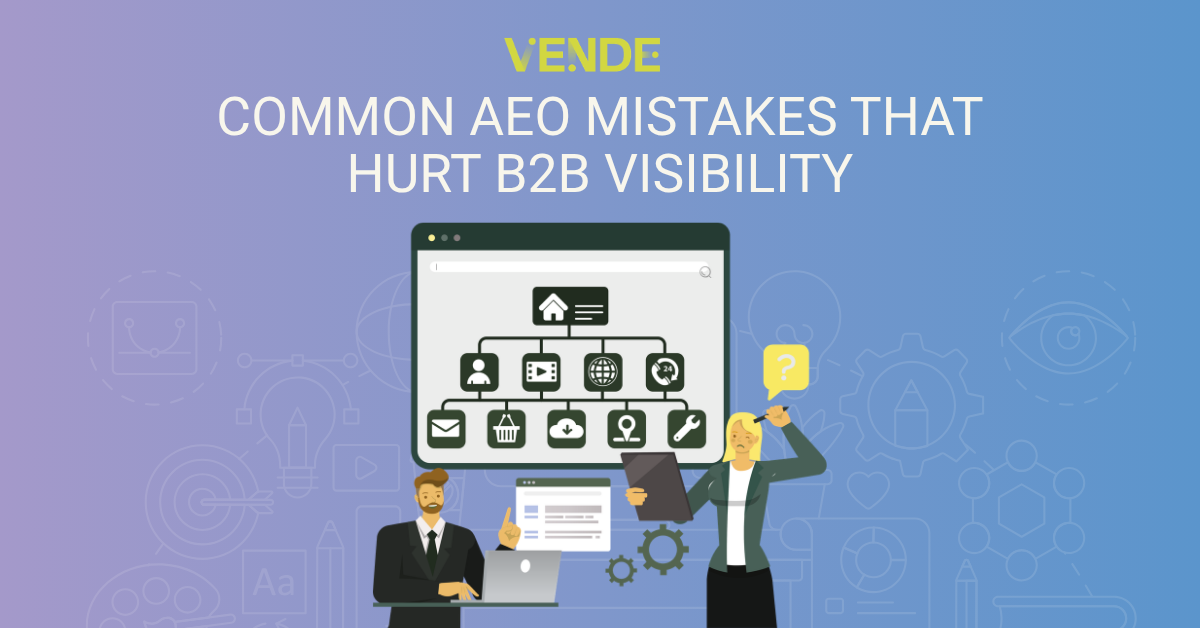
AEO is New, but the Mistakes Feel Familiar
.png?width=1200&height=628&name=1%20(1).png)
Every once in a while, marketing actually shifts.
Not a small tweak. Not a new tactic. A real shift.
The brands that navigate those shifts successfully tend to have something in common: they adapt quickly. According to the webinar, this is one of those moments because it’s impacting both traffic and performance in a big way.
And yet, most of the mistakes B2B marketers are making with AEO (answer engine optimization) look… suspiciously familiar.
That’s because:
- The terminology keeps changing (SEO, AEO, LMO… pick your acronym)
- The tactics are evolving fast
- And most teams are trying to apply old SEO habits to a very different search environment, one shaped by evolving AI search strategy.
It’s a bit like relying on instincts that once worked, even after the environment has changed. Think of a fox adjusting to a changing landscape instead of following the same path every day. The smartest operators adapt quickly. The rest keep following patterns that no longer lead anywhere.
Here’s the reality:
You’re not wrong to care about AEO.
But you might be chasing the wrong outcomes, or using the wrong playbook to get there.
Let’s fix that.
What do B2B marketers get wrong about AEO?
A lot of marketers are still chasing traffic like that’s the end goal. And to be fair, that’s how we’ve been trained to think. But AEO shifts that a bit. Buyers are doing more of their research inside AI tools, which means they may never visit your site in the first place. So it’s less about how many clicks you can generate and more about whether your brand shows up early enough to influence the decision.
Mistake #1: Treating AEO Like Just Another Name for Blogging
For years, the question was simple:
“How do we get our content to rank?”
Now, many marketers are asking:
“How do we get our content seen in AI?”
That’s the wrong question.
The better question is:
How do we get our brand seen and positioned as the answer to their problem?
Because here’s the catch:
- Informational blog content often doesn’t get cited in AI answers
- Buyers can get answers without ever clicking your site
- More content ≠ more visibility
Publishing more blogs won’t solve AEO.
Shifting from content volume → brand visibility will.
Mistake #2: Measuring Success by Website Traffic
This one’s a bit of a shift.
Traffic used to be the metric everyone cared about. That was the goal. But with AEO, it doesn’t really work the same way anymore. Buyers are finding answers earlier in the process, often before they ever visit a website. In the webinar poll, the results were clear: most marketers said they care more about being mentioned or recommended than about driving clicks.
And that tracks.
AEO returns are a bit fuzzier. You might not always get the click, but you’re still influencing the buyer along the way.
That means success starts to look a little different:
- Brand mentions in AI answers
- Recommendations in tools like ChatGPT or Google AI Overviews
- More branded search over time
- Visits that lean more toward pricing, services, or contact pages.
Because if someone already has a level of trust before they land on your site, it’s just a different kind of visit.
Mistake #3: Over-Relying on Top-of-Funnel Content
B2B marketers are wired to think:
“More educational content = more growth.”
And for a long time, that was true.
But it doesn’t quite work the same way anymore.
AI has changed the game, especially in how buyers move from digging through pages to just getting the answer they need.
Informational queries are often handled instantly now, without a click.
Research-and decision-stage questions are where brands actually start to show up and get evaluated.
So instead of cranking out endless “what is…” content, it makes more sense to shift toward things like: comparison pages, “best fit” content, service and solution pages, and other evaluation-stage resources.
That’s where visibility and real influence tend to happen.
Mistake #4: Thinking SEO and AEO Are Separate Strategies
A common misconception:
“You need one strategy for SEO and another for AEO.”
You don’t.
You need a better strategy overall.
Because:
- Good SEO can still drive traffic
- Good AEO can drive visibility and trust
- And both work best when built around brand authority
If your SEO strategy is just blogging, it’s probably underperforming in both worlds.
If it’s built around:
- Brand clarity
- High-intent content
- Authority signals
You can win at both.
Mistake #5: Believing Your Website Is the Whole Game
Here’s a big one.
AI doesn’t just look at your website.
It pulls from:
- Review platforms (Clutch, G2, etc.)
- Directories
- Google Business Profiles
- Social platforms
- Third-party mentions
In fact, AI tools are basically connecting dots across the internet.
Which means:
Your website is just one of those dots.
If everything else is inconsistent or weak? You’re harder to understand and harder to recommend.
Mistake #6: Inconsistent Messaging Across the Web
This is where things tend to fall apart.
Most B2B teams actually have the right pieces in place:
- A solid ICP
- Clear positioning
- A polished messaging doc
But once you look online, it’s a different story.
You’ll find different descriptions across your website, LinkedIn, review platforms, and directories, sometimes all saying slightly different things. None of it is completely wrong; it just doesn’t line up.
And that’s where the problem starts.
AI relies on consistent signals to understand what you do. If your messaging changes depending on where someone finds you, it becomes harder to connect the dots.
Then there’s the language piece. Teams use words that make sense internally, but they’re not always the same words buyers use.
That’s really the issue. Not that the messaging is bad, it’s just not consistent enough to be clear.
Mistake #7: Assuming Structure Alone Is Enough
Yes, structure matters.
Clear headers, FAQs, bullet points… all good.
AEO-friendly content should be easy to scan, answer one question at a time, and use clear formatting.
But structure alone won’t save you.
Because if:
- The topic is too broad
- The competition is too strong
You still won’t get mentioned.
Smaller brands especially need to be strategic:
- Pick winnable topics
- Focus on niche relevance
- Avoid going head-to-head with massive players on generic terms
Mistake #8: Trying to Be Everywhere
“Be visible everywhere.”
Sounds good. But it’s often executed badly.
Because what many teams actually do is:
→ Show up randomly across platforms
→ Spread efforts too thin
→ Lose consistency
The smarter approach:
- Choose the platforms that matter for your audience
- Focus on quality over quantity
- Build depth, not just presence
Don’t put all your eggs in one basket.
But don’t scatter them across the internet either.
What B2B Marketers Should Do Instead
.png?width=1200&height=628&name=2%20(1).png)
Let’s simplify this.
AEO isn’t about gaming the system.
It’s about becoming a brand worth mentioning.
That means:
- Shift from content-first → brand-first thinking
- Focus on research and decision-stage visibility
- Align messaging across every platform
- Build strong off-site signals (reviews, mentions, authority)
- Track the right metrics (not just traffic)
And most importantly:
Treat this like a discipline, not a campaign.
Because AEO (like SEO) is less like running ads…
…and more like building and maintaining a house.
It takes consistency, awareness, and a willingness to adjust as the environment changes.
A fox doesn't survive because it's constantly chasing every movement around it. It survives because it pays attention to the signals that matter.
The Biggest AEO Mistake? Thinking Too Small
.png?width=1200&height=628&name=3%20(1).png)
AEO isn’t just about “winning answers.” It’s about being discovered earlier, building trust faster, and ultimately being the option buyers choose.
The teams that treat it like “SEO, but with AI” tend to struggle. The ones that approach it as a brand visibility play, something that shows up across the entire buyer journey, are the ones that actually see results.
The difference often comes down to perspective. If you're only focused on rankings or clicks, it's easy to miss the bigger picture. The brands gaining traction in AI search are the ones looking beyond individual tactics and building visibility across the entire ecosystem.
If this all feels like a lot, it doesn’t have to be.
We put together an AI Visibility Cheat Sheet to help you focus on what actually moves the needle, so you can show up in AI answers, build trust faster, and stop chasing traffic that never converts.
Key Takeaways
- AEO mistakes often come from applying outdated SEO thinking.
- Traffic is no longer the primary success metric; visibility and trust are.
- Top-of-funnel content alone won’t drive meaningful AEO results.
- SEO and AEO can (and should) work together.
- Your website is only part of the equation; off-site signals matter.
- Consistent messaging is critical for AI understanding.
- Structure helps, but topic strategy matters just as much.
- AEO is an ongoing discipline, not a one-time fix.
-2.png)
%20VD-4-26-2-Why%20B2B%20Teams%20Need%20to%20Shift%20From%20Lead%20Generation%20to%20Buyer%20Enablement-1.png)
.png)
-1.png)