 29-May-2026
AI answers are not just changing search. They’re changing buyer behavior, pipeline generation, and how modern GTM systems must operate.
Twenty-five years ago, I got into B2B marketing because I could see what the internet was about to do to the B2B world. For the first time, buyers no longer needed to rely entirely on sales teams to access information, research solutions, or evaluate vendors. Websites became the new front door to learning, and search accelerated that shift by making discovery nearly instant.
Buyers have always followed the path of least resistance when gathering information and making decisions. The internet made information easier to access. Search made it easier to find. Content, social media, and communities made it easier to learn independently without speaking to a salesperson.
This week, Google announced what it called its biggest Search update in 25 years. Most reactions online focused on the death of SEO and what it means for traffic, but I think they miss the more important shift beneath it all.
Google’s announcement puts a spotlight on something many B2B teams have been noticing for a while: buyers are doing a lot more homework before they ever show up in your funnel. They’re researching options, comparing vendors, talking to peers, and forming opinions long before they fill out a form or take a sales call. AI isn't creating that behavior. It's making it easier and faster.
Search is becoming more conversational.
Discovery now happens through AI answers rather than blue links or by reading thousands of words on our websites.
That matters enormously for B2B companies because most go-to-market (GTM) systems were built around observable buyer behavior: website visits, form fills, demo requests, inbound conversions, and attribution paths. What happens when Google essentially sends us no more traffic? Those signals still matter, but they no longer provide a complete understanding of how people make buying decisions.
That is why so many B2B teams feel increasing disconnects between traffic and pipeline, attribution and influence, and activity and revenue outcomes. It is why outbound feels harder, why buyers seem to appear “out of nowhere,” and why traffic no longer correlates as cleanly to pipeline creation as it once did.
For example, many B2B marketing teams are still focused on generating leads through clicks, form fills, and demo requests. In a clickless buying environment, the companies that win will increasingly be the ones identifying warming accounts earlier through engagement, topic interaction, and buying-group activity, and distributed content consumption before the official hand-raise ever happens.

That changes how Marketing measures influence, how RevOps surfaces engagement, and how Sales prioritizes outreach.
The visible buyer journey is shrinking while the invisible learning layer continues expanding.
Buyers are still researching, evaluating, validating ideas internally, and comparing vendors. What changed is where that activity happens and how visible it is to your GTM system.
Historically, the click represented the beginning of the buying journey. That assumption no longer holds water. Buyers may never visit websites directly before the hand-raise, and vendor evaluation now happens across AI interfaces, communities, social platforms, peer networks, and recommendation environments that sit outside traditional attribution models.
The website still matters. Search still matters. But neither sits at the center of the buying journey the way they once did. The visible funnel is increasingly downstream of invisible learning.
What Google Actually Changed and Why It Matters for B2B
The most important part of Google’s announcement is less about the interface and more about how buyers will discover and evaluate information moving forward:
- Search becomes conversational instead of keyword-driven
- AI-generated answers and recommendations will replace traditional links to websites
- AI agents will perform tasks and research on behalf of users
- Ongoing “information agents” will monitor topics continuously in the background
- Buyers can compare, evaluate, and build confidence before ever visiting a website
- AI systems increasingly organize and interpret vendor information before meaningful human interaction happens
Announced New Features
- The Intelligent Search Box is designed for longer, conversational queries rather than short keyword searches. Users can ask more complex questions, upload documents or images directly into Search, and receive synthesized responses without manually navigating across multiple websites.
- Generative UI enables Search to dynamically create tables, dashboards, visualizations, simulations, and interactive experiences directly within search results. In one example, a student explored black holes through an interactive model generated entirely within Search. No website visit or external experience required.
- Information Agents are AI-powered agents that continuously monitor topics, industries, news, and market changes in the background, then automatically synthesize and surface updates. Instead of manually revisiting websites or repeating searches, buyers can increasingly rely on AI systems to monitor and organize information on their behalf.
AI is removing another layer of friction.
For years, the search was like a traffic cop. It pointed you in a direction and was never meant to be the destination. Buyers searched for information, reviewed options, clicked links, and pieced together answers themselves. The website became the center of the buying journey because it was the primary place buyers went to educate themselves and evaluate vendors.
None of these changes eliminates search or websites. Yet, they are big steps in enabling buyers by removing effort/friction while creating an environment that is less observable/trackable for B2B companies.
Now buyers can ask complex questions and receive organized answers immediately. That shift has major implications for B2B companies because it compresses the visible buying journey even further, as more buyer activity now occurs before traditional intent signals appear in your GTM system.
Traffic is becoming a less reliable measure of GTM effectiveness.
Traffic visibility and buyer visibility are no longer the same thing. A buyer may consume your content through AI-generated summaries, hear your perspective on LinkedIn, encounter your brand in peer conversations, or see your ideas referenced across multiple channels before ever clicking through to your website. By the time they become visible inside your CRM, much of the education and vendor evaluation process may already be complete.
The goal is no longer just generating clicks and capturing leads. It is building a GTM system that can create influence before the visit, surface buyer movement earlier, and help Sales engage warming accounts before competitors do.
Why B2Bs Are Struggling to Keep Up
Most B2B GTM systems were built around observable buyer behavior (ad clicks, website visits, content downloads, form fills). That model made sense when the website sat at the center of the buying journey.
Today, much of the buying process occurs before most of these observable moments, creating a growing visibility gap for B2B teams.
- Outbound feels less effective
- Attribution feels less trustworthy
- Traffic becomes less predictive
The reality is that marketing teams have always influenced deals long before measurable engagement appeared in reporting. Much of that influence simply wasn’t visible or accounted for, which historically led to the impact of marketing being undervalued.
This is why many companies feel like pipeline generation has become harder to explain, even when meaningful buyer engagement is still happening.
Buyers did not stop researching or evaluating vendors. They simply found lower-friction ways to do it. The Google announcement is primarily a buyer visibility problem, not an SEO/AEO problem.
To win, we will need to build GTM systems designed around how modern buyers actually behave, rather than how traditional funnels assumed they would.
The Simplest Way to Think About the Clickless Future
Some companies will spend the next year complaining about what AI search means for traffic, attribution, and SEO. Others will adapt to how buyers are increasingly choosing to learn and evaluate solutions.
The reality is buyers have always followed the path of least resistance. AI simply removes another layer of friction from how people discover information and build confidence.
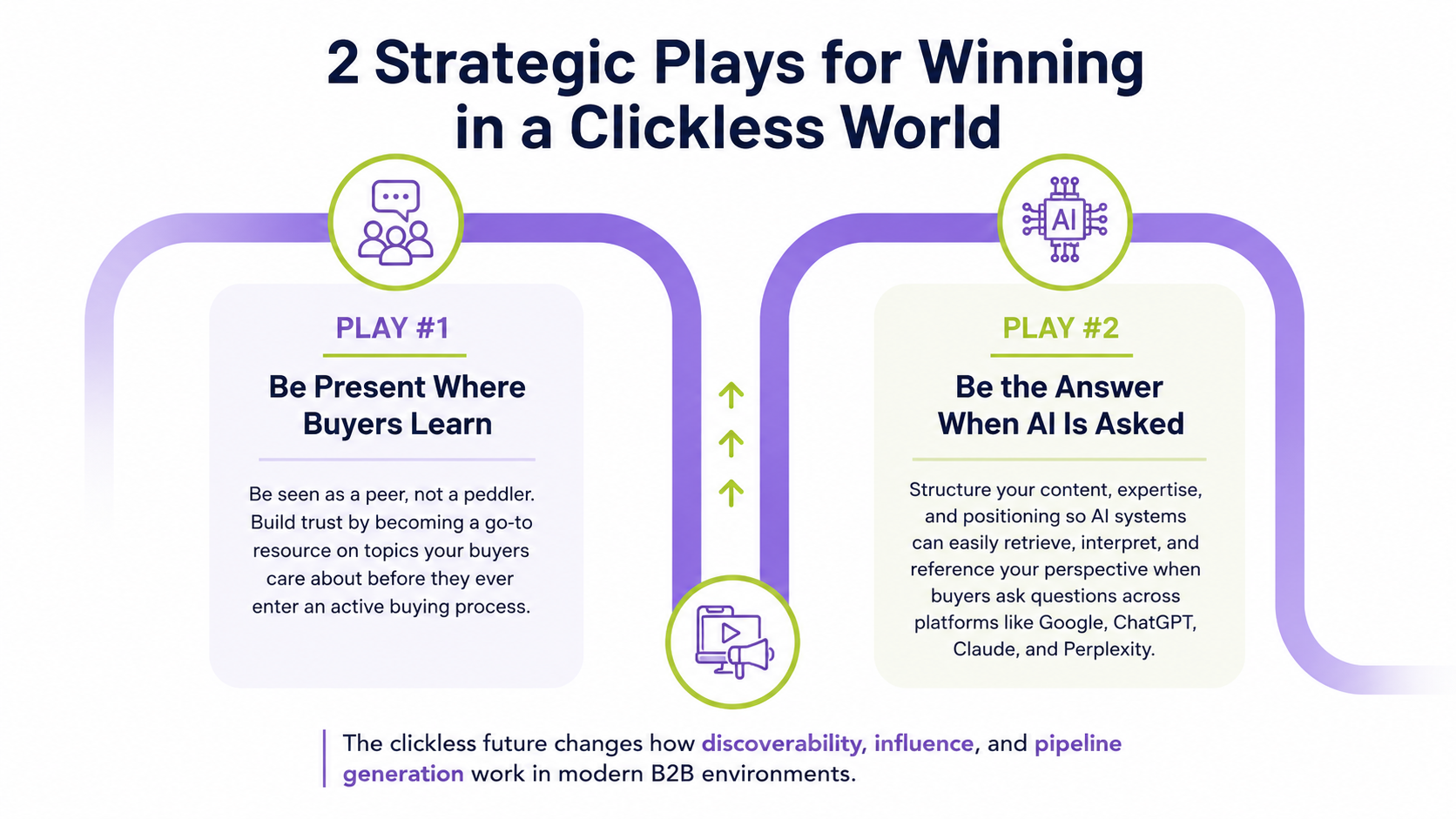
Google is going to keep moving in this direction, whether B2B companies like it or not. The smarter response is learning how to become more visible, more discoverable, and more useful within this new environment by focusing on two areas:
- Be present in channels where your buyers go to learn - Be seen as a peer, not a "peddler," and become their go-to resource on topics you know more about than they do.
- Be the Answer When AI is Asked (AEO) - Structure your content, expertise, and positioning so AI systems can easily retrieve, interpret, and reference your perspective when buyers ask questions across platforms like Google, ChatGPT, Claude, and Perplexity.
That shift changes how discoverability, influence, and pipeline generation work in modern B2B environments.
The B2B Buying Journey Has Already Changed
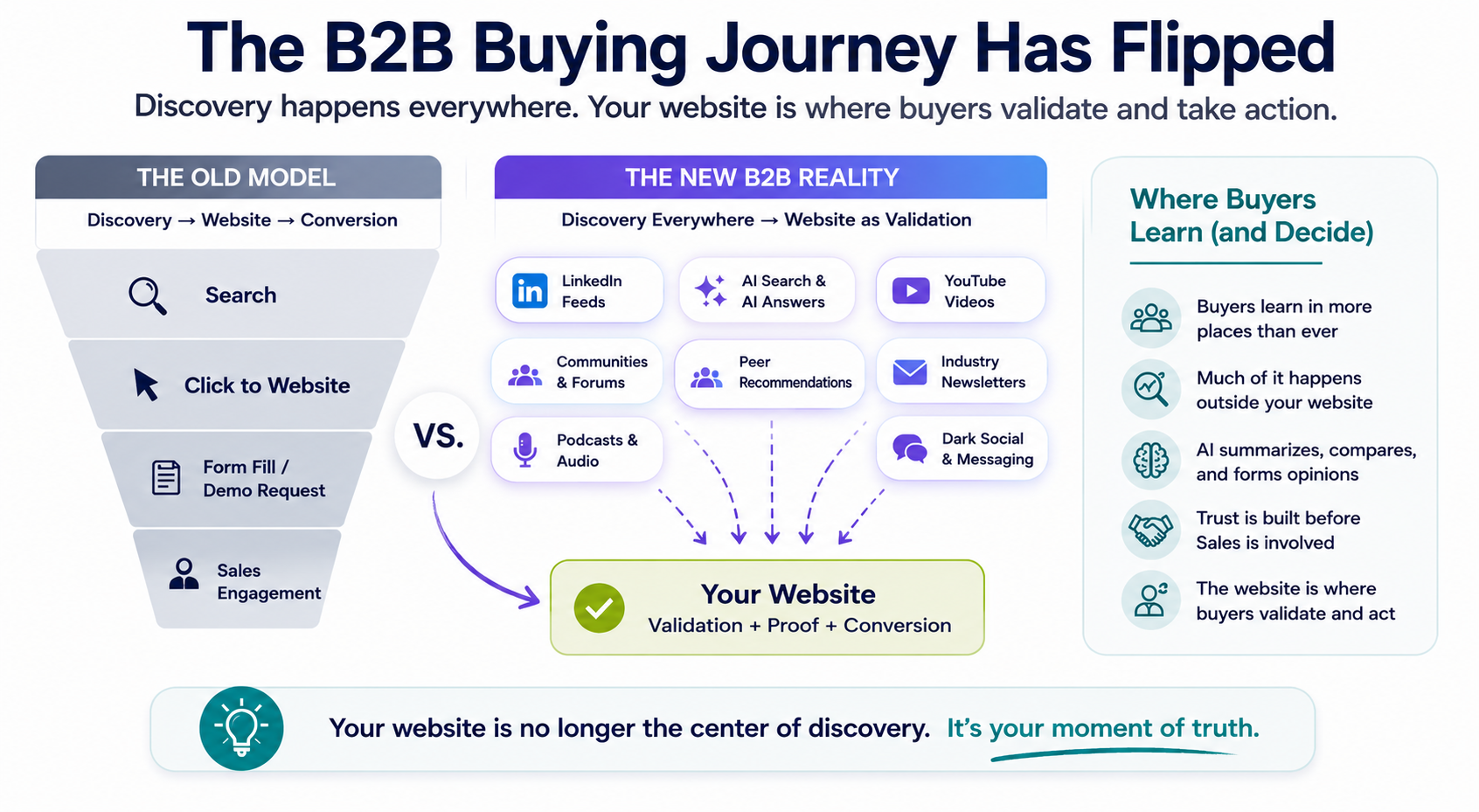
One of the biggest mistakes B2B teams still make is assuming their website sits at the center of the buying journey.
For years, most GTM systems were designed around a “marketing funnel” that didn’t really exist. B2B buyers rarely follow a linear path, and these changes have only exacerbated the issue.
Today, discovery happens across LinkedIn feeds, AI-generated answers, YouTube, communities, peer recommendations, podcasts, newsletters, dark social, and countless other environments, long before a direct website visit.
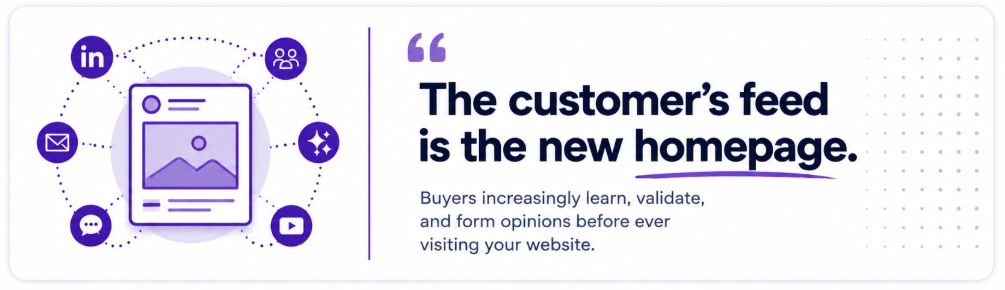
The website still matters enormously, but its role is changing. Increasingly, the website functions as a validation and conversion layer rather than the primary place buyers discover and learn about vendors for the first time.
That shift has major implications for discoverability, trust-building, attribution, signal capture, and how pipeline generation systems need to operate moving forward.
What B2B Teams Should Prioritize Right Now
Focus on these three areas: improving buyer visibility, strengthening discoverability, and operationalizing buyer movement earlier in the buying journey.
1. Build Authority and Discoverability Before the Hand-Raise
The information you produce needs to become easier to understand, easier to trust, and easier to associate with the problems you solve before direct engagement ever happens.
That starts with:
- strengthening your POV and positioning
- clearly communicating what problems you solve
- reinforcing consistent expertise across channels
- modernizing your AEO/SEO discoverability strategy
- publishing content where buyers already spend time learning
Generic messaging fades quickly in AI-mediated discovery environments. The companies gaining traction are usually very clear about what is broken in the market, why it is happening, what buyers should do differently, and proof that their approach works.
2. Improve Buyer Visibility and Signal Capture
Most GTM systems were built around form fills and inbound conversions, but much of today’s buying activity happens before those signals ever appear. That is pushing B2B teams to improve how they:
- Identify warming accounts earlier
- Surface buying-group engagement
- Aggregate signals across channels
- Recognize account-level momentum
- Help Sales prioritize accounts already showing signs of movement
Traffic visibility and buyer visibility are becoming increasingly disconnected. Build your GTM system so you can recognize meaningful buyer activity earlier and respond while there is still time to influence the decision.
Vende helps companies address this directly by configuring GTM environments to capture and surface first-party behavioral signals so sales aren't waiting on a form fill to know who's paying attention.
3. Align GTM Systems Around How Modern Buyers Actually Buy
The clickless future changes more than search behavior. It changes how Marketing, Sales, and RevOps need to work together around visibility, timing, and buyer engagement.
- Move beyond traffic as the primary success metric
- Build account-centric GTM systems
- Helping Sales engage with better timing and context
- Create influence before direct engagement occurs
- Measure pipeline momentum beyond last-touch attribution
The goal is to build GTM systems that reflect how modern buyers actually research, evaluate vendors, and make purchasing decisions.
The Clickless Future Is Really About Buyer Enablement
The more I think about Google’s announcement, the less I believe this is fundamentally a search story. It is a buyer behavior story.
Every major shift in B2B marketing over the last 25 years has followed the same pattern: buyers gravitate toward lower-friction ways to access information, build confidence, and make decisions.
The internet reduced the need to talk to Sales. Search reduced the friction required to discover answers. Content, communities, and social platforms allowed buyers to educate themselves independently and validate ideas across broader networks.
AI is simply the next evolution of that progression.
The challenge for modern B2B teams is learning how to create visibility, influence, and pipeline momentum in a buying environment where much of the research, evaluation, and decision-making process now happens outside our website and traditional funnel visibility.
Google did not create this shift. Buyers were already moving in this direction. Google simply validated where buyer behavior is heading next.
What We’re Helping Clients Navigate Right Now
Most B2B teams are still trying to figure out how this shift impacts their visibility, pipeline strategy, SEO/AEO approach, content model, and Sales motion.
Right now, a lot of our client conversations are centered around:
- Improving buyer visibility before the hand-raise
- Adapting SEO and discoverability strategies for AI-mediated search
- Strengthening POV and positioning in increasingly synthesized buying environments
- Helping Sales identify warming accounts earlier
- Building GTM systems that surface buying momentum before traditional conversion events occur
If your team is trying to make sense of how these shifts affect your GTM strategy, let's talk about how to improve buyer visibility, strengthen discoverability, and build pipeline in the clickless future.

-2.png)
%20VD-4-26-2-Why%20B2B%20Teams%20Need%20to%20Shift%20From%20Lead%20Generation%20to%20Buyer%20Enablement-1.png)