
 13-Jul-2026
Summary
- Most B2B messaging strategies fail because they’re built on internal assumptions rather than buyer reality.
- Research suggests companies correctly identify the most important buying driver only about 8% of the time.
- Buyers care less about company attributes and more about outcomes, certainty, and risk reduction.
- Strong messaging starts with customer research that uncovers what buyers actually value and need to hear.
Your homepage sounds great.
The positioning feels polished. The value proposition has been refined. Sales has weighed in. Leadership has weighed in. Product marketing has weighed in. Everyone agrees the messaging is clearer, sharper, and more differentiated than before.
Then the campaign launches.
And nothing happens.
Engagement is flat. Conversions don't improve. Sales conversations sound eerily similar to the ones you were having before.
When this happens, companies often assume they have a messaging problem. They start rewriting headlines, tweaking calls to action, or searching for a more creative way to tell their story.
But what if the problem isn't how you're saying it?
What if the problem is what you're saying?
That was one of the most interesting themes from a recent discussion with customer research expert Grant Gooding. During the conversation, he shared a statistic that should make every marketer pause before approving their next homepage revision.
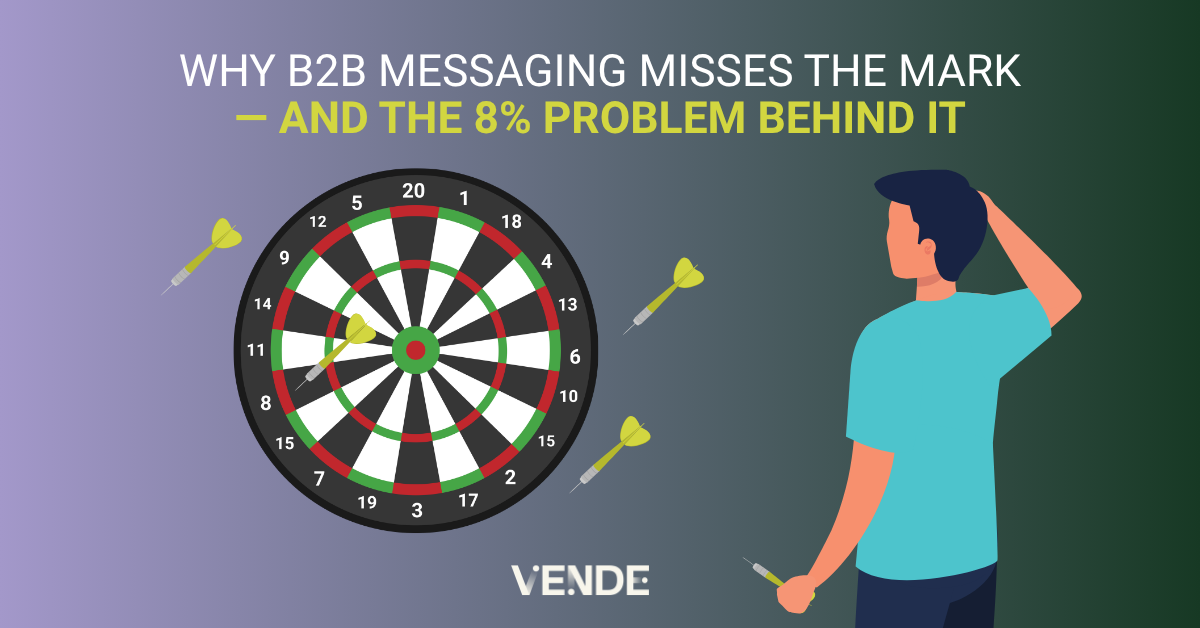
According to Grant, companies correctly identify the most important buying driver for their audience only about 8% of the time.
Not 80%.
Eight.
Most B2B messaging doesn't fail because it's poorly written.
It fails because it's built around assumptions buyers don't share.
The danger is that companies become so familiar with their own story that they stop questioning whether buyers see it the same way.
And that gap has real consequences. Buyers are doing more research on their own, involving more stakeholders in decisions, and consuming more information before ever engaging with a vendor. In fact, much of the buying journey now happens long before an opportunity ever enters the pipeline. If your messaging is built on assumptions rather than buyer reality, you're asking buyers to do extra work to connect the dots.
Most won't.
They'll move on to the company that makes the value clearer, the outcome more obvious, and the decision easier to justify. As buyers increasingly encounter brands through industry conversations, peer recommendations, AI-generated answers, and independent research, messaging has become more than a website exercise. It's often the first impression buyers have of your business. It’s the lens through which they evaluate everything else they learn about you.
-1.png?width=1200&height=628&name=1%20(1)-1.png)
Why does B2B messaging miss the mark?
B2B messaging often misses the mark because companies build it around internal assumptions rather than buyer insights. Teams focus on what they believe makes their company valuable instead of validating what buyers actually care about. An effective B2B messaging strategy begins with understanding buyer motivations, concerns, and decision criteria before creating content, campaigns, or sales messaging.
Why Do Companies Misunderstand What Buyers Value?
Most organizations assume they have a good understanding of why customers choose them. After all, they're the ones delivering the product or service.
The problem is that buyers evaluate those same strengths through a completely different lens.
A company may believe its proprietary process is what sets it apart. Leadership may point to company culture. Sales may credit responsiveness or customer service. Another organization may emphasize being employee-owned or family-owned. These characteristics may be important to the business, but buyers don't automatically see them as reasons to choose one vendor over another.
None of those things is necessarily wrong.
But buyers rarely make decisions because of attributes alone. They make decisions based on what those attributes mean to them.
Being employee-owned may create greater accountability.
A proprietary process may reduce implementation risk.
A highly experienced team may help avoid costly mistakes.
Those outcomes are what buyers care about.
The challenge is that many organizations stop at the attribute and never make the leap to the outcome. That's where messaging begins to drift away from buyer reality.
Why Does Internal Bias Hurt B2B Messaging?
One of the biggest obstacles to effective buyer messaging is proximity.
The closer you are to your business, the harder it becomes to see it the way buyers do.
Inside the organization, everyone understands why certain differentiators matter. Buyers don't have that context. They're spending their days thinking about their own challenges, priorities, and risks.
That's why messaging often becomes filled with things that sound important internally but don't immediately connect externally.
When a company says it offers white-glove service, buyers don't automatically understand what that means. When a website claims to be innovative, buyers don't know how innovation benefits them.
The missing piece is almost always the same question:
So what does that do for me?
The best messaging doesn't force buyers to connect those dots themselves.
It connects the dots for them.
This disconnect is more common than many teams realize. What marketers believe they're communicating and what buyers actually take away from a message are often two very different things. Understanding that gap is one of the fastest ways to improve the effectiveness of messaging. That's exactly why we created What Buyers Hear vs. What Marketers Say, a guide that explores how buyer perception often differs from marketer intent.
-1.png?width=1200&height=628&name=2%20(1)-1.png)
Why Do Words Like Quality, Trust, and Service Fail?
Words like quality, trust, and customer service appear everywhere in B2B marketing because they feel safe.
The problem is that every competitor claims them.
After a while, those words stop carrying meaning.
Buyers respond to specifics, not categories.
Customer service isn't the message. The behaviors that demonstrate customer service are the message.
Trust isn't the message. The evidence that creates trust is the message.
There's a big difference between saying, "We provide exceptional customer service," and saying, "Every client receives direct access to a senior account leader throughout the engagement."
One is a claim.
The other is something buyers can picture.
Specificity creates credibility.
Credibility creates confidence.
And confidence helps move buyers forward.
Why Do Buyers Choose the Safest Decision Instead of the Best One?
Many marketing teams assume buyers are making purely rational decisions.
In reality, B2B buying is far messier than that.
Buyers aren't just evaluating potential upside. They're also evaluating risk. They're wondering whether implementation will be painful, whether adoption will happen, and whether the decision will reflect well on them internally.
Gartner research has found that modern B2B buying decisions are increasingly complex, involving more stakeholders, more information, and more uncertainty than ever before. As complexity rises, buyer confidence often becomes just as important as product superiority.
This is also why engagement signals can be misleading. Buyers often spend significant time researching, learning, and exploring solutions before they're ready to make a decision. Mistaking that activity for true buying intent can lead teams to build messaging around the wrong assumptions.
The safer option often feels easier to defend.
Strong value proposition messaging doesn't just communicate value. It reduces uncertainty.
In many cases, buyers don't need more information. They need enough confidence to act. The companies that win are often the ones that remove uncertainty, answer unspoken concerns, and make the next step feel easier to justify internally.
-1.png?width=1200&height=628&name=3%20(1)-1.png)
How Does Customer Research Improve B2B Positioning?
If most messaging problems stem from assumptions, the obvious solution is better customer research.
Yet many organizations still struggle to uncover useful insights despite conducting surveys, interviews, and customer conversations.
Part of the problem is that direct questions don't always produce meaningful answers.
Ask someone what matters most when selecting a vendor, and you'll often receive a polished, rational response. Ask the same person to react to a statement or challenge an assumption, and you may uncover something far more revealing.
A highly effective technique known as elicitation focuses less on asking buyers for direct answers and more on creating opportunities for them to reveal what they truly believe.
The goal isn't to collect opinions.
The goal is to uncover motivations, fears, decision criteria, and sources of hesitation.
Those insights form the foundation for stronger buyer messaging, more effective B2B positioning, and a more credible value proposition.
Because once you understand what buyers actually care about, messaging becomes significantly easier.
Better Messaging Starts Before the Copywriting
If your messaging feels stuck, the answer isn't another round of copy revisions.
More often, the problem is that the message was built on assumptions your buyers don't share.
Strong messaging is no longer confined to a homepage, sales deck, or nurture sequence. Buyers are piecing together their perception of your company across dozens of interactions and channels. The message needs to hold together wherever they encounter it.
The fix isn't more clever copywriting. It's a deeper understanding of what buyers value, what they fear, what they need to believe, and what proof helps them feel comfortable moving forward.
At Vende, we help organizations align their positioning, messaging, content, and buyer insights with how modern B2B buyers actually make decisions. If your messaging isn't producing the results you expected, it may be time to revisit the assumptions behind it. Our team helps organizations uncover the gaps between what companies believe buyers value and what buyers actually need to hear before taking action.
Contact us to start a conversation about strengthening your messaging, improving buyer engagement, and creating a clearer path to revenue growth.
Because messaging that lands isn't the message your team likes best; it's the message your buyers recognize as true.
Key Takeaways
- Most B2B messaging misses because it is built on internal assumptions rather than buyer reality.
- The "8% problem" highlights how difficult it is for companies to identify what buyers value most accurately.
- Internal differentiators only matter when they are translated into meaningful customer outcomes.
- Buyers are looking for confidence and certainty, not simply the best solution on paper.
- Effective customer research uncovers motivations, fears, and decision criteria that strengthen messaging.
- Strong value proposition messaging reduces uncertainty and helps buyers feel safe moving forward.
- Clear, specific messaging consistently outperforms vague claims and marketing jargon.

-2.png)
%20VD-4-26-2-Why%20B2B%20Teams%20Need%20to%20Shift%20From%20Lead%20Generation%20to%20Buyer%20Enablement-1.png)

.png?width=352&name=Featured%20Image%201%20(1).png)