 27-Feb-2026
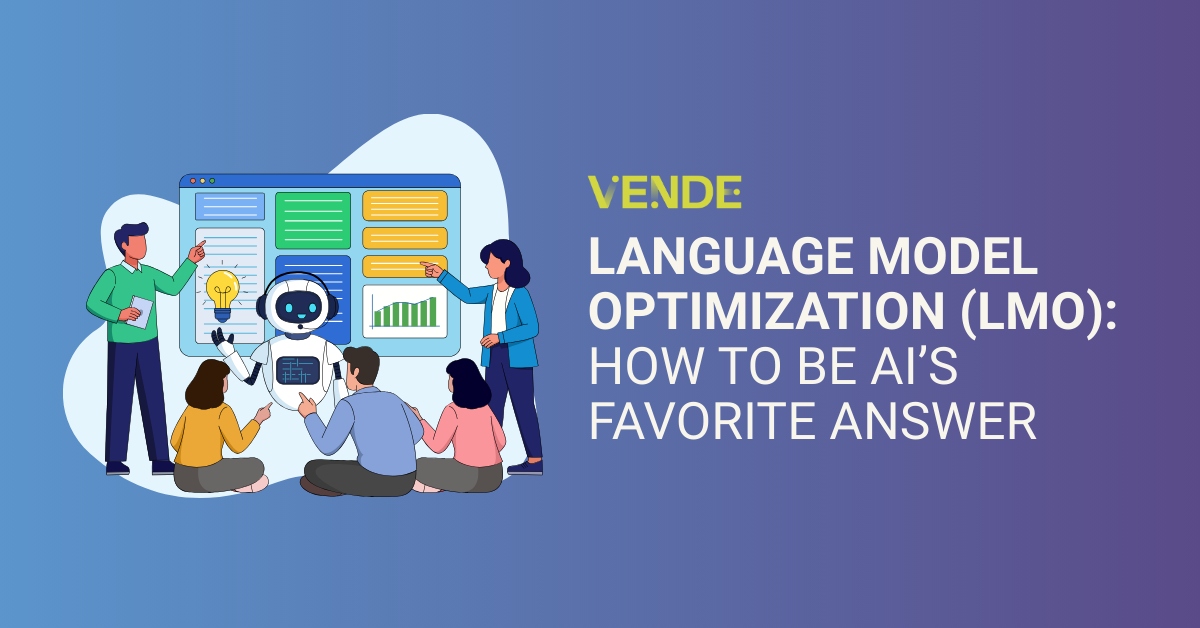
Language Model Optimization (LMO) helps your brand appear accurately in AI Overviews, chatbots, and assistants. Buyers now ask AI first, click later, and evaluate vendors without ever touching your website. LMO gives you control over the facts that AI retrieves and repeats about your company, products, and expertise. Keep your language consistent, give AI clear sources, and share those details across the places it learns from. That’s how your brand becomes the version it repeats.
What is Language Model Optimization (LMO), and how do you actually use it?
Language Model Optimization (LMO) is the process of guiding how AI systems talk about your brand and answer questions in your category. It works by making your key information consistent, easy to cite, and structured in a way models can understand. To use LMO effectively, make your brand boilerplate consistent everywhere, publish quotable resources such as clear definitions and data points, use clean answer-first structure in your content, and distribute authoritative references across the websites and platforms that AI models are most likely to learn from.
How has visibility changed now that AI answers first?
AI Overviews, chatbots, and assistants no longer wait for your website to rank. Buyers ask a question, and the machine responds instantly, using patterns from content the model has already digested.
Visibility is no longer “Can my page rank?"
It is “Will AI quote me correctly and consistently?”
This guide shows you how to engineer the signals these models rely on so your definitions, data, and descriptions become the ones they trust enough to repeat.
How is LMO different from SEO?
SEO helps your pages climb Google’s results.
LMO helps machines describe your brand accurately on every platform.
SEO cares about crawlability, keywords, and backlinks.
LMO cares about entities, canonical facts, consistent phrasing, and where those facts live.
The shift is simple: stop optimizing only pages. Start optimizing the truth about your brand. Success now includes accurate AI descriptions, shortlist presence, and showing up in high-intent discovery moments — even when no one clicks. As Rand noted in the Exploring the Clickless Future Growth Show, traffic is a vanity metric. Influence is the new currency.
What should be in your entity graph?
.jpg?width=1200&height=628&name=1%20(1).jpg)
Your entity graph is the set of facts AI needs to “know” about you. When this foundation is inconsistent, AI descriptions fall apart.
Inventory and lockdown:
- Company identifiers: Name, one-sentence descriptor, HQ, founding year, funding stage, product names, core features
- People: Founders and SMEs with consistent roles and expertise
- Category framing: The 1 or 2 category labels you want tied to your brand
- Evidence sources: Your website, LinkedIn, Crunchbase, G2/Capterra, docs, GitHub, Wikipedia, if relevant, partner pages
This becomes your brand’s source of truth. If these inputs are unstable, AI outputs will be too.
How do you standardize the words that train the model?
Consistency may feel boring, but to LLMs, it is a love language. Vende’s LMO guidelines emphasize strong, clear headers, answer-first formatting, and consistent phrasing across every surface.
Start with:
- A 50–70 word boilerplate used verbatim across bios, directories, socials, and partner pages
- Product one-liners you do not reinvent every quarter
- A glossary with one definition per core term
- A shared “entity pack” for Marketing, PR, Sales, RevOps, and Partners
Rand said it best during the session: AI isn’t magical; it just repeats the stuff it runs into the most. So the words you use over and over really do shape how it talks about your brand.
What makes content citable to AI models?
.jpg?width=1200&height=628&name=2%20(1).jpg)
AI tools pick up on content that’s easy to follow and easy to grab. When your information is organized, straightforward, and backed by real sources, the model is far more likely to pull from it instead of guessing.
Publish:
- A “What is ___?” hub with crisp first-paragraph answers and FAQ schema
- Original data sets with charts, methodology notes, and sample sizes
- Comparison matrices with transparent features and “best for/not for” clarity
- Implementation guides with a step-by-step structure
- Formatting that starts with the answer, then context, then proof
Vende creates answer-first content because it’s easier for humans to scan and for AI to extract.
Where should you distribute signals so models actually see them?
Getting your LMO work in front of the right eyes isn’t about hitting publish and hoping for the best. You have to publish it where AI systems are actually pulling information.
A simple place to start:
- Share your strongest pieces with industry groups or niche publications
- Get transcripts posted for podcasts or webinars you appear on
- Keep your docs and GitHub repos up to date
- Ask partners to refresh your boilerplate on their sites
- Do a little monthly PR outreach to earn a few solid citations
AI models rely heavily on repeated, reputable signals. Give them more of you in more high-authority places.
How do you structure content so machines (and humans) love it?
Content structure is now a competitive advantage. Good structure improves ranking, readability, and AI extractability.
Use:
- FAQ pages, How-tos, and Article schema
- Strong question-based headings
- Clear tables, labeled figures, and alt text describing the chart’s findings
- Canonical tags, stable URLs, date stamps, and transparent edit history
- TL;DR boxes, key facts bullet lists, and quotable callouts
- Clean citations to primary research
If a machine can understand your structure, it can reuse it.
How do you measure LMO without chasing perfect attribution?
LMO success is measured with signals, not vanity metrics. This aligns with what Rand highlighted in the transcript: clicks will decline, but buying behavior will not.
Because of this, it’s important to track:
Accuracy
Are AI tools describing your brand correctly in a fixed monthly prompt set?
Presence
How often do you appear in AI Overviews for your target terms?
How many external sites cite your definitions or data?
Demand
Is branded search volume rising?
Do buyers mention AI or Overviews when self-reporting?
Outcomes
Are demo rates, win rates, and time-to-first-meeting improving?
This is your executive-friendly scorecard.
What does a 30–60 day LMO sprint look like?
.jpg?width=1200&height=628&name=3%20(1).jpg)
You do not need a massive transformation. Start with a focused sprint.
- Create your entity pack with boilerplate, category labels, SME bios, and product one-liners
- Update all surfaces (site, socials, partners, event listings) with the canonical copy
- Publish one “What is ___?” hub with FAQs and schema
- Release one data asset and syndicate it to five reputable outlets
- Build a transparent comparison page
- Convert SME talks into structured articles
- Baseline your prompt tests, branded search, and demo rates
- Review trends monthly
In two months, your brand will become dramatically more “AI-ready.”
Ready to make AI say your name the right way?
Contact us to discover your best LMO opportunities and develop a strategy that helps your brand appear accurately in AI-driven search.
Key Takeaways
- LMO helps your brand become the source AI relies on, not just a page that ranks.
- Consistency wins by training models to describe you accurately.
- Citable resources like definitions, data, and comparison pages increase AI visibility.
- Distribution matters. Seed facts across high-authority sites.
- Success is measured by accuracy, citations, and demand, not pageviews.
Next actions:
- Deploy a 50–70-word boilerplate everywhere.
- Publish a “What is ___?” hub with FAQ schema.
- Release a small data set with 3–5 charts.
- Build a clear comparison page.
- Turn SME talks into structured articles.
- Establish an LMO scorecard with monthly AI checks.

-2.png)
%20VD-4-26-2-Why%20B2B%20Teams%20Need%20to%20Shift%20From%20Lead%20Generation%20to%20Buyer%20Enablement-1.png)
-2.png?width=352&name=Featured%20Image%20(1)-2.png)