
 10-Jun-2026
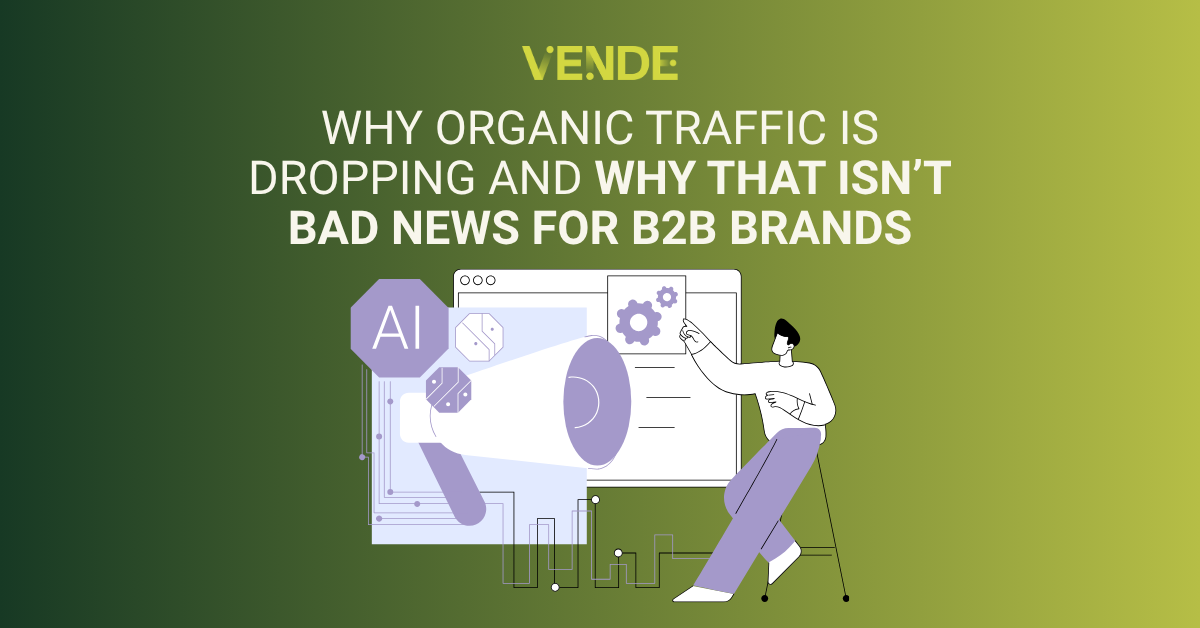
Organic traffic is down.
You’ve seen it in your reports. Your leadership has definitely noticed it.
And somewhere along the way, it starts to feel like something is broken.
But here’s the truth:
This isn’t a failure. It’s a shift in how buyers find answers today.
The catch is that most teams are looking at the wrong metric.
While overall traffic is dropping, not all of it matters equally; what’s left is higher-intent traffic that’s getting the green light and driving real results.
Why is high-intent organic traffic getting better even as overall traffic drops?
What’s changing is where the early research happens. AI tools are answering those top-of-funnel questions, so fewer people need to visit your site for basics. The ones who do show up have already done their homework, which makes them much more likely to take action.
AI Search Is Changing What Gets Clicked (and What Doesn’t)
Let’s start with what’s actually happening.
Buyers no longer need to visit your website to learn the basics. Tools like Google AI Overviews, ChatGPT, and Perplexity are now doing that work, delivering clear, summarized answers instantly. It’s part of a broader shift in how AI is changing search behavior.
As a result, the biggest drop is happening in:
- “What is…” searches
- Top-of-funnel blog content
- Broad educational traffic
Why? Because AI is answering those questions before a click ever happens. Buyers can now “ask one machine and get a lot of really good research information” without visiting multiple websites.
So yes, overall traffic drops.
But that traffic was often:
- Early-stage
- Low intent
- Unlikely to convert
Losing it isn’t the problem people think it is.
The Buyers Who Still Click Are More Informed
.png?width=1200&height=628&name=VD-3-26-1-1%20(1).png)
Here’s the part most marketers are underestimating:
the people who actually click through now aren’t starting from zero.
By the time they land on your site, they’ve usually already looked into the problem, compared a few options, and seen different takes on how to solve it, maybe even come across your brand along the way.
So they’re not showing up asking, “What is this?”
It’s more like they already have a sense of what they’re looking for. The questions shift a bit, now it’s, “Is this the right fit?” or “Can I trust this?” or even just, “What do I do next?”
And that changes things.
Because by the time they get to you, a lot of that initial trust has already been built. They’re not just clicking around; they’re trying to figure out if they should move forward.
AI tools and search engines are doing the early validation, so when a buyer arrives, they’re already warmer and closer to action.
What the Data Shows: Less Blog Browsing, More Buying Behavior
You can see this shift pretty clearly in how people behave once they land on your site.
It used to look something like this: someone finds a blog post, reads for a bit, and then leaves. Maybe they learned something, but they weren’t really moving any closer to a decision.
Now it’s different.
When someone clicks through, they’re much more likely to head straight to your homepage or a service page, poke around your pricing, and check out what the next step looks like. They’re not just reading; they’re actively evaluating.
Instead of bouncing after a blog, people are moving deeper into the site, reviewing services, pricing, and what to do next.
Even more telling: “High-intent traffic is better than it’s ever been.”
That’s not a traffic problem. That’s a pipeline opportunity.
Why Branded Search Is Rising (and Why You Should Care)
At the same time traffic is dropping, something else is climbing fast:
Branded search.
Buyers are discovering brands through:
- AI tools
- Podcasts
- Peer recommendations
- Review sites
Then they go to Google and search for the brand directly.
That’s a completely different behavior.
A branded searcher is not casually browsing. They are:
- Validating
- Comparing
- Deciding
Brand searches have “skyrocketed” alongside these shifts!
Which means:
Your real growth signal isn’t traffic, it’s recognition.
SEO Isn’t Dead: It’s Evolving Into AEO
.png?width=1200&height=628&name=VD-3-26-1-2%20(1).png)
Let’s clear something up.
SEO is not going away.
But it is changing.
Old SEO focused on:
- Traffic volume
- Ranking for broad keywords
- Publishing large amounts of informational content
That worked when clicks were easy.
Now? The strategy is shifting toward:
- Mid-funnel content
- Decision-stage content
- Brand visibility across the web
Teams are seeing stronger results by focusing less on informational content and more on high-intent pages.
This is where SEO and AEO (answer engine optimization) start to overlap.
It’s not just about where you rank anymore. What matters more is whether your brand shows up in the right places, whether you’re being mentioned, recommended, and recognized before someone ever clicks through.
Because in this environment, attracting more traffic isn’t the goal in itself. What matters is whether that traffic is actually moving in the right direction.
What B2B Marketers Should Measure Instead
If traffic isn’t the north star anymore, what is?
The teams getting this right are looking at different signals.
Things like:
- More people searching for your brand
- Visitors making it to services and pricing pages
- People sticking around and exploring
You’ll also see it in what happens next, whether someone clicks deeper into the site, checks out your contact page, or actually turns into an opportunity.
Because 1,000 low-intent visits don’t move pipeline in a world of zero-click searches.
But when the right visitors show up and move forward, that’s what actually drives results.
Before You Panic About Traffic Drops, Check These First
Before rewriting your entire strategy, take a breath and look at the right signals.
1. Are high-intent pages performing?
Check service, pricing, and solution pages.
2. Is branded search increasing?
If more people are searching your name, your visibility is working.
3. Are users engaging more deeply?
Look at:
- Pages per session
- Time on site
- Navigation paths
Better behavior often matters more than more traffic.
4. Is your content too top-heavy?
If most of your content is informational, you may be over-indexed on traffic that AI is replacing.
5. Are you visible beyond your website?
AEO pulls from across the internet, not just your site.
That includes:
- Review platforms
- Industry sites
- Directories
AI doesn’t just rely on your website; it builds trust from multiple sources across the web.
Better Traffic Beats Bigger Traffic
.png?width=1200&height=628&name=VD-3-26-1-3%20(1).png)
Yes, organic traffic is dropping.
But that doesn’t mean performance is.
It means:
- Buyers are doing more research before clicking
- AI is filtering out low-intent visits
- The visitors who arrive are more qualified
And that’s exactly what B2B teams should want.
Because the goal was never to maximize clicks.
It was to:
Attract the right buyers, at the right time, with the right level of trust already built.
And by that standard, organic traffic isn’t getting worse. It’s getting smarter.
If this shift has you rethinking how you measure success, you’re not alone. The teams winning right now aren’t chasing more traffic; they’re building systems that attract and convert the right buyers. If you want to see where your current strategy stands, take our Pipeline Growth Assessment and identify exactly where you’re losing momentum and how to fix it.
Key Takeaways
- Overall organic traffic is dropping due to AI answering early-stage questions.
- High-intent organic traffic is improving and converting better.
- Buyers are arriving more informed and closer to decision-making.
- Branded search growth is a key signal of stronger intent.
- SEO is evolving toward AEO, prioritizing mid- and bottom-funnel content.
- Success should be measured by engagement and conversions, not just traffic volume.
%20VD-4-26-2-Why%20B2B%20Teams%20Need%20to%20Shift%20From%20Lead%20Generation%20to%20Buyer%20Enablement-1.png)
.png)
-1.png)
%20VD-4-26-2-Why%20B2B%20Teams%20Need%20to%20Shift%20From%20Lead%20Generation%20to%20Buyer%20Enablement-1.png?width=352&name=(1200x628)%20VD-4-26-2-Why%20B2B%20Teams%20Need%20to%20Shift%20From%20Lead%20Generation%20to%20Buyer%20Enablement-1.png)
.png?width=352&name=Featured%20Image%201%20(1).png)