
 06-May-2026
If your team keeps rewriting your homepage copy, debating headlines, or cycling through new value props every quarter, there’s a good chance the problem isn’t the words.
It’s the decisions underneath them.
Positioning is often conflated with messaging; it’s treated like wordsmithing. Find the right phrase. Tighten the headline. Make it sound more differentiated. But positioning is upstream of messaging.
If your positioning is unclear, messaging will always be hard. No amount of copy polish can fix that.
But once your positioning is clear, messaging stops being a guessing game. The right words are easier to find because you know which tools to use and which to leave in the box. It becomes obvious what to say, what to emphasize, and what to leave out.
That clarity comes from four inputs. Miss one, and messaging gets mushy fast.
What are the four inputs to positioning that make messaging easier?
Messaging usually gets hard when teams skip a few basic decisions. You have to be clear on what buyers are actually comparing you to, what you do differently in practice, why that difference matters to their business, and which customers feel that problem the most. When those things are settled, writing copy stops feeling like guesswork.
Why does messaging feel hard when positioning is mushy?
You can usually spot mushy positioning right away. Here’s the tell: everything sounds impressive but vague.
Claims like “powerful” or “flexible” show up everywhere, and pages are packed with features. Yet somehow, none of it explains why someone should choose one company over another.
The Marketing team tends to feel the friction first because they are expected to create demand without a clear story. Sales pushes back when the messaging doesn't align with how deals are actually won, and Leadership senses something’s off, even if they cannot quite name it.
This is why sales-and-marketing aligned, buyer-first messaging matters. When teams share a clear view of the buyer, messaging stops breaking at the handoff.
The issue is structural; messaging is downstream of positioning. Without clear inputs, teams can’t create clear messages.
If you want messaging to feel straightforward, make the strategic decisions first.
Input #1: Competitive alternatives
Who are you really up against?
You cannot have a position without knowing what buyers compare you to.
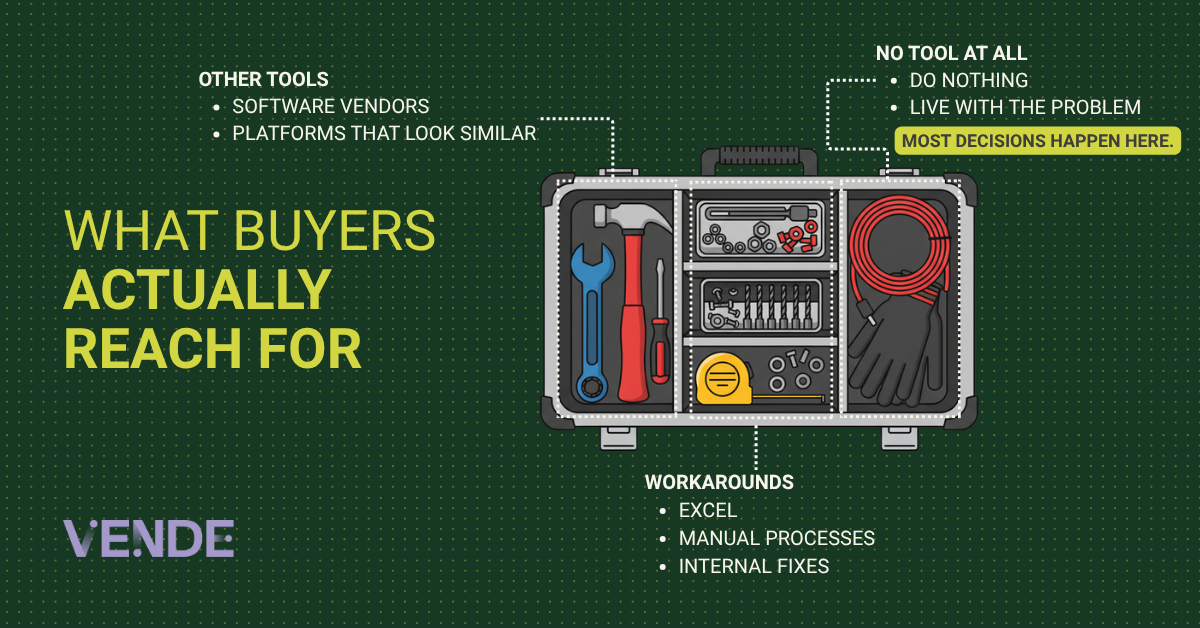
Competitive alternatives are not just vendors that look like you. They include:
- Shortlist competitors that sales sees in active deals
- The status quo, such as Excel, an intern, or manual workarounds
- Broad solution approaches help buyers mentally group together
The most common miss is the status quo. In B2B, many deals are lost because buyers decide that doing nothing is good enough. Want proof? Excel beats more companies than its biggest funded competitor. Is it the best? No, but it’s status quo.
Another mistake is treating future competitors as if they are present ones. Product teams often plan for where the market might go, while buyers focus on the options in front of them right now. If a company never makes it into the buyer’s comparison set, it does not belong in today’s positioning.
What matters is understanding the choices buyers actually make and the shortcuts they take when they decide to do nothing. That is the real landscape buyers reach for when they open the toolbox.
Input #2: Differentiated capabilities
What can you do that alternatives cannot?
Capabilities are often mistaken for messaging, but they are not the same thing. They are the underlying strengths of the product or the company that support the story. The catch is that they only matter when they are real, easy to prove, and actually different from what buyers can get elsewhere. Otherwise, they just become noise.
A lot of teams get stuck here because everything sounds important internally. AI, automation, flexibility, scale. The problem is that buyers hear those words everywhere, so without context, they do not signal anything useful.
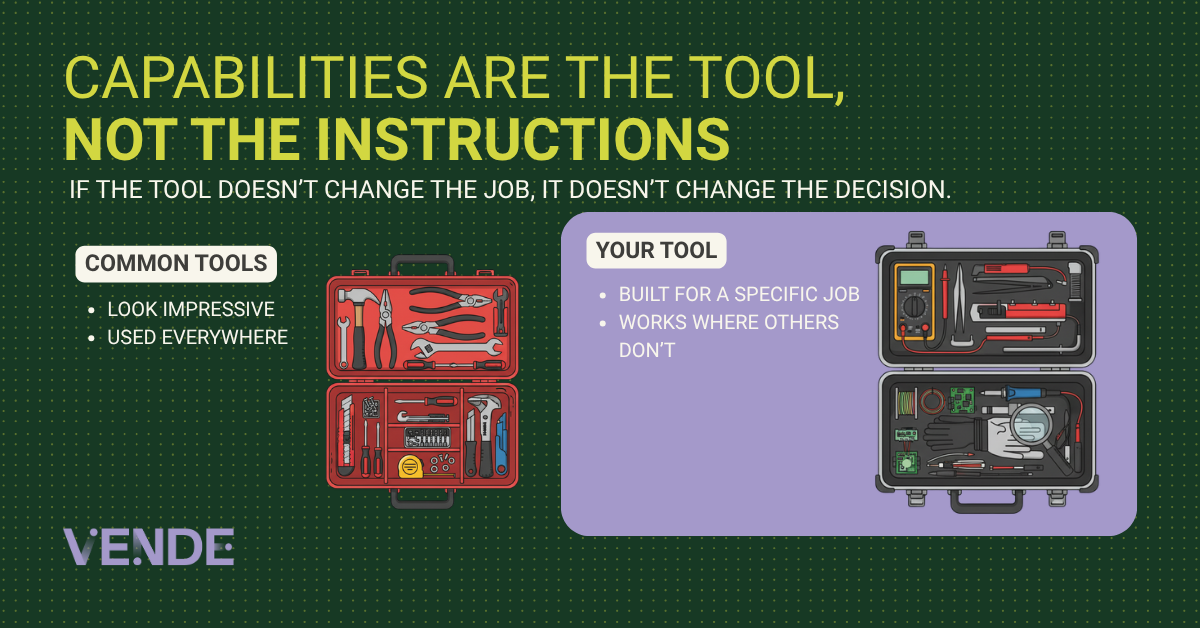
The difference only shows up when you look at what other options are optimized for and where your approach takes a meaningfully different path.
If a capability does not change the buying decision, it does not belong in positioning. It might be interesting. It might be real. But it is not differentiated.
Input #3: Differentiated value
The answer to “why pick you?”
Differentiated value explains why a buyer should choose you over every alternative.
The fastest way to get there is the “so what” ladder:
- Capability
- What does that enable?
- What does that change for the business?
That difference becomes clearer when you look at how it plays out in practice. A fuzzy-logic algorithm might sound impressive on its own, but that is not what customers respond to. What matters is how it changes the experience. Support teams stop treating questions like tickets that drag on for days and start resolving them in real time. That shift improves retention, which is what actually influences the decision.
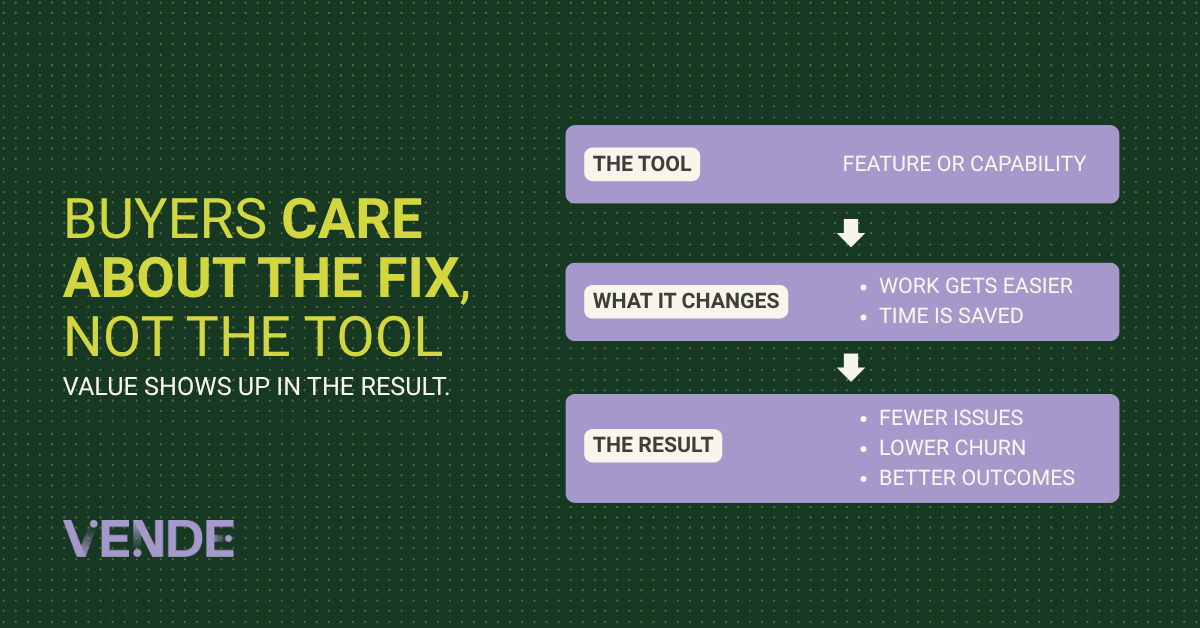
This is where messaging often goes off the rails. Teams settle on value that sounds fine but does not really change a business outcome. Buyers are not moved by feature lists. They care about what improves, what gets easier, or what risk goes away. The strongest positioning usually focuses on a small set of value themes instead of trying to say everything at once.
Input #4: Best-fit customer and category context
Who cares most about your value?
Not every buyer reacts the same way to your value. Some feel the problem immediately, while others barely notice it. Messaging gets sharper once teams focus on the customers who:
- Actually feel the pain
- Pay a price when it drags on
- Already understand enough about the problem to see why a change matters
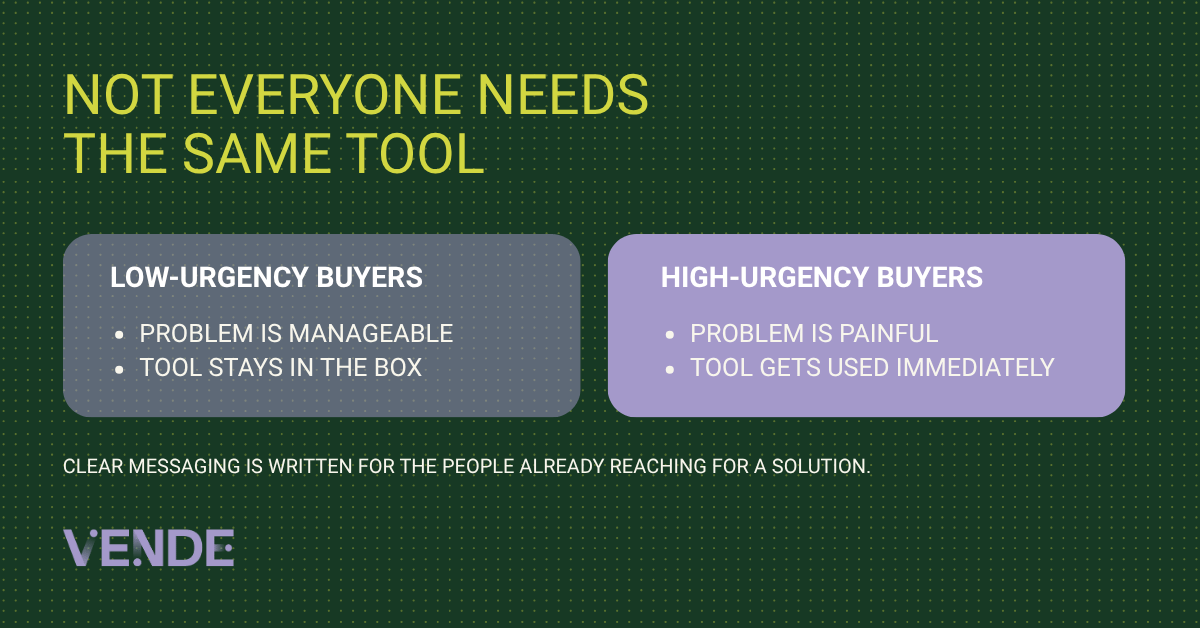
Going broad can feel like the smart move, especially early on. But it often creates more confusion than flexibility.
When the message is built for everyone, it’s not urgent for anyone.
Start with a smaller, clearer audience instead to create focus and the confidence that makes expansion easier later.
How do the four inputs turn into messaging?
When the inputs are clear, messaging now becomes a translation. Competitive alternatives shape your contrast language. Differentiated value turns into the headline and core narrative. Capabilities become actual proof instead of promises. And your best-fit customers influence tone, examples, and specificity.
A simple messaging map looks like this:
- Headline focused on differentiated value
- Subhead that clarifies who it is for and how it fits
- Two or three value pillars
- Proof points, stories, and metrics underneath
- Clear contrast with why alternatives fall short
If messaging feels difficult, one of these inputs is missing or unresolved.
How should positioning be validated?
Positioning is best validated in sales conversations, not on landing page tests.
A/B testing messaging introduces too many variables. Design, traffic quality, phrasing, and timing all influence outcomes. When the results change, it is often unclear why.
A more reliable approach:
- Turn positioning into a sales pitch narrative
- Test it with five to ten qualified prospects
- Watch reactions, confusion, and objections
- Iterate based on real conversations
- Look for the green light moment when a strong rep prefers the new pitch
When sales adopts the story willingly, positioning is now working.
Key Takeaways
- Positioning is a set of strategic decisions, not a messaging exercise. Clear inputs make messaging easier.
- Competitive alternatives include the status quo and not just vendors that look similar.
- Differentiated capabilities only matter if they are provable and relevant to real buying decisions.
- Differentiated value comes from climbing the “so what” ladder until it connects to revenue, cost, risk, or time.
- Messaging gets sharper when you focus on the best-fit customer who feels the problem most strongly.
Want to see where your positioning is helping or holding you back?
Take this 5-minute Pipeline Growth Assessment to see which parts of your go-to-market toolkit need attention.


-2.png)
%20VD-4-26-2-Why%20B2B%20Teams%20Need%20to%20Shift%20From%20Lead%20Generation%20to%20Buyer%20Enablement-1.png)
.png?width=352&name=Featured%20Image%201%20(1).png)