 19-Feb-2026
Let’s be honest. Your partners follow the path of least resistance. If launching your campaign means juggling five different logins, embarking on a digital scavenger hunt for assets, and facing a blank page for copy, they will stall. Or worse, they’ll run a competitor's program that’s actually easy to execute. Hope, as we know, is not a strategy. But a frictionless partner experience is a solid strategy.
This is for channel leaders and partner marketers charting their course to more frequent campaign launches, with consistent branding and a measurable pipeline. When you make working with your team as intuitive as following a well-marked treasure map, you capture mindshare. And when you capture mindshare, your partners don’t just join the crew; they become a powerful extension of your brand, helping you uncover new revenue streams.
What is a “Frictionless” Partner Experience?
A frictionless partner experience means your partners can go from idea to a live campaign in hours, not weeks. It’s about removing the tiny cuts that bleed time and kill momentum. In a world where partners manage relationships with multiple vendors, the one who makes it easiest to succeed captures the attention.
You might be dealing with friction if you recognize these symptoms:
- Scattered Portals: Partners need a separate login for training, marketing assets, and MDF claims.
- Asset Overload: A massive, disorganized library of content where partners can’t find what’s relevant to them.
- Unclear Approvals: Creative and messaging get stuck in a black hole waiting for your brand or legal team.
- Inconsistent Co-Branding: Partners are left to manually add their logo, often breaking your brand guidelines.
- Manual Proof for MDF: Partners have to cobble together spreadsheets and screenshots to get reimbursed.
When you eliminate these headaches, you achieve outcomes that directly impact your bottom line: higher partner activation rates, shorter campaign launch cycles, a more assisted pipeline, and better brand consistency across your entire ecosystem.
Map the Partner Journey to Find the Sand
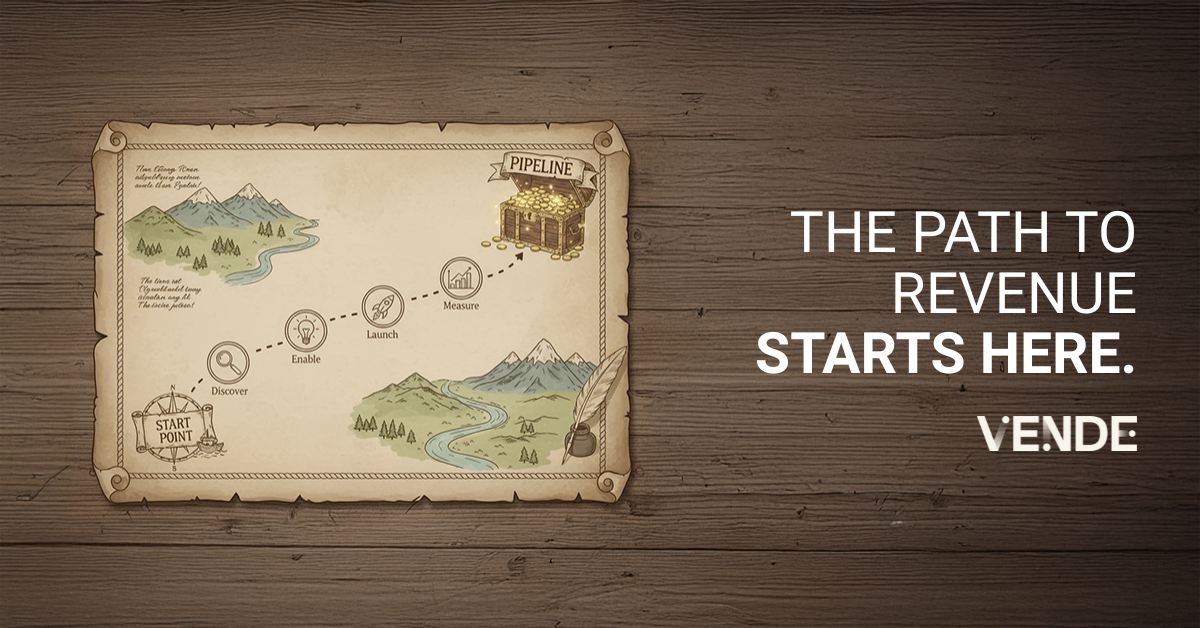
Before you can remove friction, you need to chart where obstacles lie along the partner journey. Picture grabbing a whiteboard as your treasure map and plotting the four key moments that lead partners towards your "X marks the spot" (i.e., a pipeline that pays off).
The Four Moments That Matter
- Discover: Can partners easily find your offers and understand why they win? If they need a 30-minute meeting to decode your value proposition, you've already lost their attention.
- Enable: Do they have a complete kit to run the play? A kit would include training, proof points, email copy, social posts, a landing page, and even an SDR talk track. No guesswork. No blank documents.
- Launch: Is execution truly turnkey? The gold standard is automated co-branding; opt-in is sent through a trusted system. The more clicks you remove, the more launches you’ll get.
- Measure: Can you and your partners see the results without drowning in spreadsheets? You need clear visibility into meetings set, pipeline generated, and which assets performed best.
Conduct a 60-Minute Friction Audit
Set a timer and put yourself in your partner’s shoes. How many logins do you need? List every approval step. How long does it take to go from a cold start to a scheduled campaign? Identify every dead end, including broken links, missing files, or confusing CTAs. Prioritize your fixes by impact and effort, starting where the sand is the thickest.
Q: What is a frictionless partner experience, and how do you build one?
A: A frictionless partner experience removes the barriers that slow partners from launching co-marketing and co-selling. It centralizes access (single sign-on), provides turnkey campaign kits (auto co-branding, copy, and landing pages), and guides partners with clear next steps and light automation (through-channel marketing). To build it: (1) map the partner journey, (2) fix high-friction steps first—logins, asset discovery, approvals, (3) ship an “easy button” toolkit, and (4) measure activation, launches, and assisted pipeline to iterate.
Ship the “Easy Button” for Your Partners
You don't need to embark on a year-long voyage to unearth hidden value for your partners. Zero in on practical solutions you can roll out this quarter to deliver immediate gains and chart a more direct course to revenue.
.png?width=1200&height=628&name=1(1).png)
Single Sign-On & Role-Based Views
Give your partners one front door to the treasure: training, campaign kits, MDF, and reporting. Then, use role-based views to personalize the portal. A managed service provider in the UK shouldn’t have to scroll past webinar slides for the US healthcare market. Cut the noise so they can focus on what matters to them.
Turnkey Co-Marketing Kits
Package the entire play in one downloadable kit. This kit isn’t a library; it’s a product, and products ship complete. A great kit includes:
-
4–6 social media posts with suggested images
-
A landing page template with a form
-
An SDR talk track and follow-up sequence
Implement auto co-branding where partners upload their logo once, and the system renders it across all assets. If you can localize kits for key languages and regions, you’ll be ahead of 90% of your competitors.
Through-Channel Marketing Automation (TCMA)
The magic phrase for busy partners is "click to launch." A TCMA platform lets you pre-approve creative and messaging, letting partners opt in and schedule campaigns within a safe, brand-compliant window. This approach ensures governance without the need for constant brand enforcement.
Make Momentum a Habit with Comms & Incentives
A great partner experience is rhythmic. You need a steady drumbeat of communication that tells partners what to do next and celebrates their success.
A Cadence That Nudges Action
- Monthly: "What to Run Now" featuring one hero campaign kit.
- Quarterly: "What Worked," highlighting top-performing partners and campaigns.
- On Release: Micro-updates when new kits drop.
Keep it short, visual, and useful. Nothing motivates a partner more than seeing what their peers are achieving.
Micro-Incentives for Key Actions
You get what you celebrate. Tie small rewards to the most important actions, like completing a new training module, launching a campaign kit, or submitting results. Possible rewards could be an MDF fast-track, a newsletter feature, or early access to new content.
Measure What Actually Moves the Needle
If you can’t measure it, you can’t scale it. A practical scorecard turns anecdotes into actionable decisions.
A Practical Partner Scorecard
- Activation: Percentage of partners who logged in and completed onboarding.
- Adoption: Number of kits launched per partner, per quarter.
- Performance: Meetings set, pipeline sourced vs. assisted, and win rate.
- Quality: Brand compliance rate and landing page conversion rates.
Review these metrics quarterly. Double down on the campaigns that create real pipeline and retire the duds. Feed these insights to your marketing team so the next kit you develop lands even better.
Your 30-60-90 Day Roadmap to a Better Experience
- Days 1–30: Audit friction, consolidate access with SSO, and choose two hero campaigns to productize into turnkey kits.
- Days 31–60: Launch your refreshed portal with role-based views, ship the first turnkey kit, and pilot TCMA with 5–10 strategic partners.
- Days 61–90: Add a second kit with localization, roll out your scorecard, and introduce micro-incentives.
Progress is the goal, not perfection. When partners feel the improvement with fewer clicks, faster launches, and cleaner reporting, you win their mindshare.
Stop Hoping, Start Strategizing
A frictionless partner experience is a promise you can keep. When you give partners one door, one plan, and one click to launch, you make your program the easy choice. Stop leaving your channel growth to chance and start building a system that makes partnership feel less like a chore and more like a strategic advantage.
Ready to turn your partner program into a revenue engine? Let's talk.
We’ll help you score your current friction points, identify two high-impact kits to productize, and outline a 60-day launch plan to build momentum you can feel.
Key Takeaways
- Frictionless partner experiences compress time-to-launch and multiply your assisted pipeline.
- Focus on four key moments in the partner journey: Discover, Enable, Launch, and Measure.
- The "easy button" combines single sign-on, turnkey kits, TCMA, and role-based content.
- A simple scorecard steers investment toward what your partners use to generate revenue.
Run a 60-Minute Friction Audit
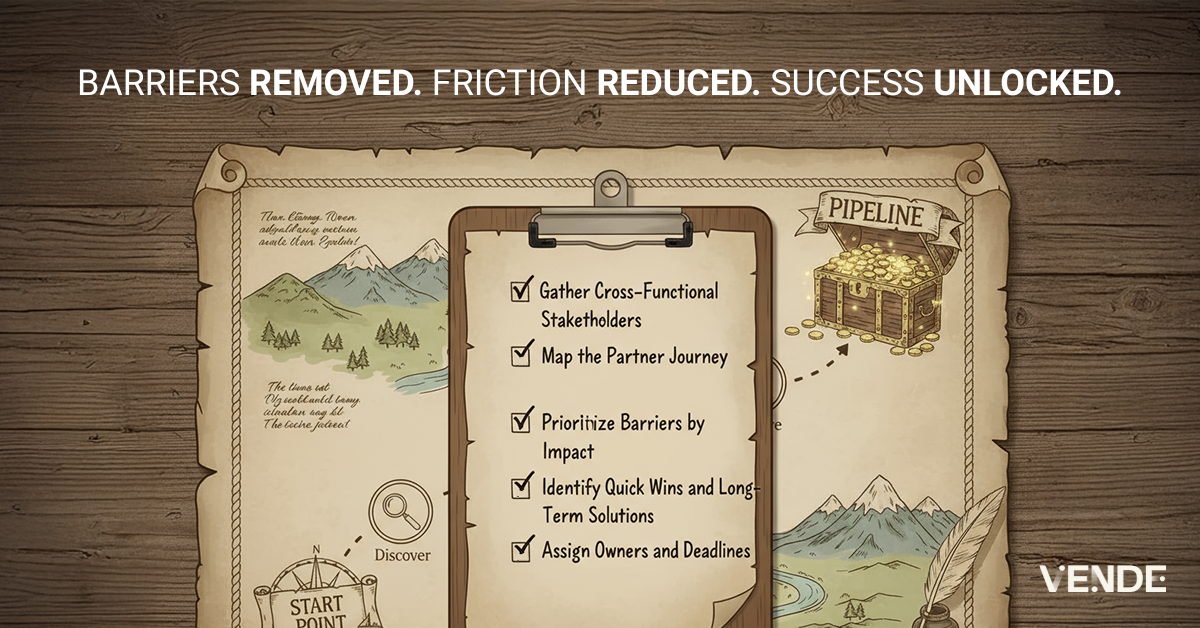
A friction audit is a simple way to spot what’s slowing partners down and fix it. In about an hour, you can surface practical insights that make the partner experience smoother and speed up results. Here’s how to run a friction audit that actually moves the needle:
- Gather Cross-Functional Stakeholders
Bring together people from sales, marketing, operations, and channel management. A mix of perspectives helps you see where slowdowns and challenges really happen. - Map the Partner Journey
Break down the partner lifecycle into the "Discover, Enable, Launch, and Measure" stages. Identify potential friction points for each stage, such as lengthy onboarding, unclear resources, or a lack of automated tools. - Prioritize Barriers by Impact
Use a simple scoring system to evaluate friction points based on their impact and effort to solve. Prioritize high-impact, low-effort fixes that can generate quick wins. - Identify Quick Wins and Long-Term Solutions
Document immediate actions your team can take to eliminate smaller barriers, while outlining a plan for resolving more complex issues over time. - Assign Owners and Deadlines
Make sure everyone knows who owns each issue and set deadlines that keep the work moving and everyone accountable.
Conducting this 60-minute friction audit enables you to proactively approach partner activation. Targeting the right areas and implementing tangible improvements reduces inefficiencies, strengthens partner relationships, and drives sustained growth.

-2.png)
%20VD-4-26-2-Why%20B2B%20Teams%20Need%20to%20Shift%20From%20Lead%20Generation%20to%20Buyer%20Enablement-1.png)